We may earn a commission when you buy through links on our deal pages, at no extra cost to you. It never changes which deals we post.
A good set of stainless steel cookware can last 20 years, handle high heat, and go from stovetop to oven. The hard part is shopping: sets that look the same run from $80 to $800. This guide explains what actually makes a difference, which brands are worth a look, and how to tell a real deal from a big piece count.
Quick answer: what makes good stainless steel cookware?
For most families, the best value is fully clad tri-ply stainless steel with an 18/10 cooking surface, a magnetic outer layer so it works on induction, riveted stay-cool handles, and oven-safe to at least 500°F. Expect to pay about $20 to $45 per real pan for that quality at regular price, and less when a set goes on sale.
Cookware buying cheat sheet
- Best everyday pick: fully clad tri-ply (stainless outside, aluminum core, stainless inside)
- Induction cooktop? Do the magnet test: a fridge magnet must stick firmly to the bottom
- Good deal price: a tri-ply 10-piece set for under about $150, or a premium brand at 25% off or more
- Red flag: a “17-piece set” where 7 pieces are lids and spoons
1. 18/10 vs 18/0: what the numbers mean
The numbers are the percent of chromium and nickel. 18/10 (or the nearly identical 18/8) resists rust and pitting and does not react with tomato, vinegar or lemon, so it belongs on the cooking surface. 18/0 has no nickel, which makes it magnetic, so makers use it on the outside to make pans work on induction. Many good pans use 18/10 inside and 18/0 outside, and that is a good sign.
2. Clad construction: the part that matters most
Stainless steel on its own spreads heat poorly. Good cookware bonds it to aluminum or copper, which spread heat fast and evenly. How that is done is the biggest difference between a $15 pan and a $100 pan.
- Fully clad tri-ply: stainless, aluminum, stainless, bonded all the way up the sides. Even heat across the bottom and sides, so sauces and dals do not scorch at the edges. The sweet spot for most homes.
- 5-ply and 7-ply: more layers, often with a thicker or copper core. Heats a little more evenly and holds heat better for searing, but costs more and weighs more. Nice to have, not a must.
- Encapsulated or impact-bonded base: a thick aluminum disc only on the bottom, with thin stainless sides. Works well for boiling, soups and pressure-style cooking, and it is cheaper. The sides can run cooler or scorch where the disc ends.
Tip: if a listing does not say “clad” or “tri-ply,” it is almost always a disc base.
3. Induction, oven and dishwasher
Induction: many newer homes come with induction or glass cooktops. Hold a fridge magnet to the bottom of the pan. If it grabs firmly, the pan works on induction. If it is weak or slides off, skip it.
Oven: most clad stainless pans are oven-safe to 500°F or more, which is great for finishing a roast or keeping food warm. Glass lids are often rated much lower, around 350 to 425°F, so check the lid separately.
Dishwasher: fully stainless pans are usually dishwasher-safe, but hand washing keeps them shiny longer.
4. Handles, rivets and lids
Riveted stainless handles are the strongest and last for decades; long, hollow handles stay cooler on the stove. Stainless lids are tougher and oven-safe, while glass lids let you watch rice or soup without lifting them. Either is fine if it fits snugly.
5. Which pieces a set should really have
You do not need 17 pieces. These four cover almost everything a family cooks:
- A 10 to 12 inch frying pan for searing, sauteing and shallow frying
- A 2 to 3 quart saucepan for rice, oatmeal, sauces and reheating
- A 3 to 4 quart saute pan with straight sides for stir-fries, curries and one-pan meals
- A 6 to 8 quart stockpot for pasta, soup, chili, stock and big batches
A 10-piece set with those pots plus lids is plenty. A pressure cooker is a separate pot: the pots in a cookware set are not built to cook under pressure, so keep your stovetop pressure cooker or Instant Pot for that.
6. Stainless vs nonstick vs cast iron vs hard-anodized
Stainless handles high heat, never wears out and does not react with acidic food, so it is the best all-round choice. Nonstick is easiest for eggs and pancakes but wears out in a few years. Cast iron is great for searing and cornbread but heavy and needs seasoning. Hard-anodized pans are light and fast but usually nonstick-coated, with the same short life. Most families do best with a stainless set plus one nonstick pan.
7. How to cook without sticking
Heat the empty pan on medium for 1 to 2 minutes, until a drop of water skates across it in a ball. Add oil, wait until it shimmers, then add food and let it sear before you move it; it releases when it is ready. Pat paneer, vegetables and meat dry first, since water causes most sticking. Medium heat is enough for most cooking because clad pans hold heat well.
8. Popular stainless cookware brands in the US
Budget: T-fal, Farberware, Cuisinart Chef’s Classic, and Tramontina’s disc-base lines. Good starter sets, mostly encapsulated bases.
Mid-range (best value): Tramontina Tri-Ply Clad, Cuisinart Multiclad Pro, Calphalon’s 3-ply stainless, and Goldilocks. Fully clad, with performance close to the premium brands for a fraction of the price.
Premium: All-Clad D3 and D5, Made In, Misen, Viking, Hestan and Zwilling. Excellent build, heirloom quality, and full prices that make them worth waiting for a sale.
9. What is a value-for-money price?
These are typical regular prices in the US. Prices change often, and sales can drop them a lot. “Per real pan” means per pot or pan, not counting lids or utensils.
| Level | Per real pan | Typical set | What you get |
|---|---|---|---|
| Budget | About $10 to $20 | About $70 to $150 | Disc-base stainless, fine for boiling, soups and everyday cooking |
| Mid-range (best value) | About $20 to $45 | About $130 to $320 | Fully clad tri-ply, induction-ready, oven-safe, lasts for years |
| Premium | About $60 to $150 | About $400 to $900 | Tri-ply to 5-ply from All-Clad, Made In, Misen, Viking, Hestan |
A good deal is a fully clad tri-ply set at a budget price, for example a 10-piece tri-ply set for under about $150, or a premium brand at 25% off or more. Some of the deals we have posted: Calphalon 3-ply stainless 10-piece set at $124.99 in October 2026, a Cuisinart 10-piece stainless set at $119.99, and an All-Clad D3 7-piece set at $349.99. Prices change, so always check the current price.
10. Cookware deals live right now
We only post a cookware deal when the price is well below its usual price. This list updates on its own every few hours.
These are live right now (prices as of 10/9/26 7:20 PM ET; they change often, so check the final price before you buy):
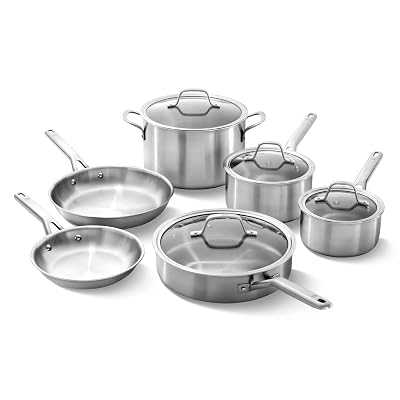
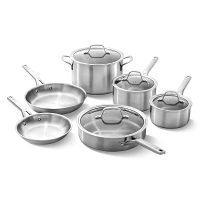
Calphalon Brushed 3-Ply Stainless Steel Cookware Set, 10-Piece
$124.99 $249.99 up to 50% off
See all Home & Kitchen deals, or get new deals as they drop on WhatsApp and Telegram.
11. Care tips that keep stainless looking new
Let pans cool before washing, since cold water on a hot pan can warp it. Add salt to water only after it boils to avoid small pits, and skip steel wool. For cleaning stains and heat tint, see the FAQ below.
See all our Home & Kitchen deals, or get new deals as they drop on WhatsApp.
Frequently asked questions
Is 18/10 stainless steel better than 18/0?
18/10 has 18% chromium and 10% nickel, so it resists rust and pitting better and keeps its shine. 18/0 has no nickel, which makes it magnetic, so it is often used on the outside of pans to make them work on induction. For the cooking surface, 18/10 is the better choice.
What does tri-ply mean on cookware?
Tri-ply means three bonded layers that run all the way up the sides: stainless steel inside, an aluminum core that spreads heat, and stainless outside. It heats more evenly than a pan with only a thick disc on the bottom.
Does stainless steel cookware work on induction?
Most clad stainless cookware does, but not all. Hold a fridge magnet to the bottom of the pan. If it sticks firmly, the pan works on induction. If it barely sticks or slides off, it will not heat well.
Why does food stick to my stainless steel pan?
Usually the pan is not hot enough or the food went in too early. Heat the empty pan on medium, add oil, wait until it shimmers, then add the food and let it sear before you try to move it. It releases when it is ready.
How many pieces does a good cookware set need?
Most families use a 10 to 12 inch frying pan, a 2 to 3 quart saucepan, a 3 to 4 quart saute pan, and a 6 to 8 quart stockpot, plus lids. A set with those pieces covers almost everything. Extra small pans add to the piece count more than to your cooking.
Is stainless steel good for high-heat cooking?
Yes. Stainless steel handles high heat for searing, stir-frying and long simmering better than most nonstick pans, and it does not react with tomato, wine or lemon. Keep a nonstick pan for eggs, crepes and other delicate food.
How do I clean burnt stains off stainless steel pans?
Soak the pan in warm soapy water, then scrub with a paste of Bar Keepers Friend or baking soda and a little water using a non-scratch sponge. For rainbow-colored heat tint, a splash of white vinegar wipes it away.
How much should a good stainless steel cookware set cost?
A good tri-ply set usually costs about $130 to $320 at regular price, roughly $20 to $45 per real pan. On sale, tri-ply 10-piece sets often drop under $150.